C# Mvc Authenticate to Upload File to Server
 The C Programming Language [1] (ofttimes referred to as K&R), the seminal book on C | |
| Paradigm | Multi-image: imperative (procedural), structured |
|---|---|
| Designed by | Dennis Ritchie |
| Developer | Dennis Ritchie & Bell Labs (creators); ANSI X3J11 (ANSI C); ISO/IEC JTC1/SC22/WG14 (ISO C) |
| Starting time appeared | 1972 (1972) [2] |
| Stable release | C17 / June 2018 (2018-06) |
| Preview release | C2x (N2731) / October 18, 2021 (2021-x-18) [3] |
| Typing discipline | Static, weak, manifest, nominal |
| Bone | Cross-platform |
| Filename extensions | .c, .h |
| Website | www www |
| Major implementations | |
| pcc, GCC, Clang, Intel C, C++Builder, Microsoft Visual C++, Watcom C | |
| Dialects | |
| Whirlwind, Unified Parallel C, Split-C, Cilk, C* | |
| Influenced by | |
| B (BCPL, CPL), ALGOL 68,[iv] assembly, PL/I, FORTRAN | |
| Influenced | |
| Numerous: AMPL, AWK, csh, C++, C--, C#, Objective-C, D, Go, Java, JavaScript, JS++, Julia, Limbo, LPC, Perl, PHP, Pike, Processing, Python, Rust, Seed7, Vala, Verilog (HDL),[5] Nim, Zig | |
| |
 C Programming at Wikibooks
C (, as in the letter c) is a full general-purpose computer programming language. It was created in the 1970s and remains very widely used and influential. By pattern, C's features cleanly reflect the capabilities of the targetted CPUs. It has constitute lasting utilize in operating systems, device drivers, protocol stacks, though decreasingly for application software, and is common in figurer architectures that range from the largest supercomputers to the smallest microcontrollers and embedded systems.
A successor to the programming linguistic communication B, C was originally developed at Bell Labs by Dennis Ritchie betwixt 1972 and 1973 to construct utilities running on Unix. Information technology was practical to re-implementing the kernel of the Unix operating arrangement.[6] During the 1980s, C gradually gained popularity. Information technology has go one of the most widely used programming languages,[vii] [8] with C compilers bachelor for the almost all modern computer architectures and operating systems. C has been standardized past ANSI since 1989 (ANSI C) and past the International Organization for Standardization (ISO).
C is an imperative procedural language supporting structured programming, lexical variable telescopic, and recursion, with a static type arrangement. Information technology was designed to be compiled to provide low-level access to memory and language constructs that map efficiently to machine instructions, all with minimal runtime support. Despite its low-level capabilities, the language was designed to encourage cross-platform programming. A standards-compliant C program written with portability in mind can exist compiled for a wide diversity of figurer platforms and operating systems with few changes to its source code.[9]
Since 2000, C has consistently ranked amidst the peak two languages in the TIOBE alphabetize, a measure out of the popularity of programming languages.[10]
Overview [edit]

C is an imperative, procedural language in the ALGOL tradition. Information technology has a static type arrangement. In C, all executable code is contained within subroutines (also called "functions", though non in the sense of functional programming). Function parameters are passed past value, although arrays are passed as pointers, i.eastward. the accost of the first item in the array. Pass-by-reference is simulated in C by explicitly passing pointers to the matter being referenced.
C program source text is free-format, using the semicolon equally a statement separator and curly braces for group blocks of statements.
The C language also exhibits the following characteristics:
- The language has a pocket-size, fixed number of keywords, including a full set of command flow primitives:
if/else,for,do/while,while, andswitch. User-divers names are not distinguished from keywords by whatsoever kind of sigil. - It has a big number of arithmetic, bitwise, and logic operators:
+,+=,++,&,||, etc. - More one consignment may be performed in a single statement.
- Functions:
- Office return values can be ignored, when non needed.
- Part and data pointers permit ad hoc run-time polymorphism.
- Functions may not exist defined inside the lexical scope of other functions.
- Variables may be divers within a role, with scope.
- A function may telephone call itself, then recursion is supported.
- Data typing is static, but weakly enforced; all data has a type, only implicit conversions are possible.
- User-defined (typedef) and compound types are possible.
- Heterogeneous amass data types (
struct) allow related data elements to be accessed and assigned as a unit. - Union is a structure with overlapping members; just the last member stored is valid.
- Array indexing is a secondary notation, defined in terms of pointer arithmetic. Different structs, arrays are not kickoff-form objects: they cannot be assigned or compared using unmarried built-in operators. There is no "array" keyword in use or definition; instead, square brackets indicate arrays syntactically, for case
month[11]. - Enumerated types are possible with the
enumkeyword. They are freely interconvertible with integers. - Strings are not a distinct data type, but are conventionally implemented as aught-terminated character arrays.
- Heterogeneous amass data types (
- Low-level access to computer retention is possible past converting motorcar addresses to pointers.
- Procedures (subroutines not returning values) are a special example of function, with an untyped return blazon
void. - Memory tin be allocated to a program with calls to library routines.
- A preprocessor performs macro definition, source code file inclusion, and conditional compilation.
- There is a bones form of modularity: files can be compiled separately and linked together, with control over which functions and data objects are visible to other files via
staticandexternattributes. - Complex functionality such as I/O, string manipulation, and mathematical functions are consistently delegated to library routines.
- The generated code after compilation has relatively straightforward needs on the underlying platform, which makes it suitable for creating operating systems and for use in embedded systems.
While C does not include sure features found in other languages (such as object orientation and garbage collection), these can be implemented or emulated, often through the use of external libraries (east.g., the GLib Object System or the Boehm garbage collector).
Relations to other languages [edit]
Many later languages have borrowed directly or indirectly from C, including C++, C#, Unix'due south C vanquish, D, Go, Java, JavaScript (including transpilers), Julia, Limbo, LPC, Objective-C, Perl, PHP, Python, Ruby, Rust, Swift, Verilog and SystemVerilog (hardware description languages).[5] These languages have fatigued many of their command structures and other basic features from C. Most of them (Python beingness a dramatic exception) likewise express highly similar syntax to C, and they tend to combine the recognizable expression and statement syntax of C with underlying type systems, data models, and semantics that can be radically different.
History [edit]
Early developments [edit]
| Year | C Standard[nine] |
|---|---|
| 1972 | Nativity |
| 1978 | K&R C |
| 1989/1990 | ANSI C and ISO C |
| 1999 | C99 |
| 2011 | C11 |
| 2017 | C17 |
| TBD | C2x |
The origin of C is closely tied to the evolution of the Unix operating system, originally implemented in assembly language on a PDP-7 by Dennis Ritchie and Ken Thompson, incorporating several ideas from colleagues. Eventually, they decided to port the operating system to a PDP-eleven. The original PDP-eleven version of Unix was as well developed in assembly linguistic communication.[6]
B [edit]
Thompson desired a programming language to make utilities for the new platform. At first, he tried to brand a Fortran compiler, but presently gave up the idea. Instead, he created a cut-down version of the recently developed BCPL systems programming linguistic communication. The official description of BCPL was non available at the time,[11] and Thompson modified the syntax to be less wordy, and similar to a simplified ALGOL known as SMALGOL.[12] The event was what Thompson called B.[6] He described B as "BCPL semantics with a lot of SMALGOL syntax".[12] Like BCPL, B had a bootstrapping compiler to facilitate porting to new machines.[12] Still, few utilities were ultimately written in B considering it was too ho-hum, and could not take advantage of PDP-11 features such every bit byte addressability.
New B and showtime C release [edit]
In 1971, Ritchie started to improve B, to utilise the features of the more than-powerful PDP-11. A significant addition was a character type. He chosen this New B.[12] Thompson started to use NB to write the Unix kernel, and his requirements shaped the direction of the language development.[12] [13] Through to 1972, richer types were added to the NB language: NB had arrays of int and char; but then were added pointers, ability to generate pointers to other types, arrays of all of these, types to be returned from functions. Arrays inside expressions became pointers. A new compiler was written, and the language was renamed to C. [6]
The C compiler and some utilities fabricated with it were included in Version two Unix.[14]
Structures and the Unix kernel re-write [edit]
At Version 4 Unix, released in Nov 1973, the Unix kernel was extensively re-implemented in C.[6] By this time, the C linguistic communication had acquired some powerful features such equally struct types.
The preprocessor was introduced around 1973 at the urging of Alan Snyder and also in recognition of the usefulness of the file-inclusion mechanisms available in BCPL and PL/I. Its original version provided only included files and simple string replacements: #include and #define of parameterless macros. Soon after that, it was extended, more often than not by Mike Lesk and then past John Reiser, to comprise macros with arguments and conditional compilation.[vi]
Unix was one of the first operating system kernels implemented in a language other than associates. Earlier instances include the Multics system (which was written in PL/I) and Master Control Plan (MCP) for the Burroughs B5000 (which was written in ALGOL) in 1961. In around 1977, Ritchie and Stephen C. Johnson fabricated further changes to the language to facilitate portability of the Unix operating system. Johnson'due south Portable C Compiler served equally the basis for several implementations of C on new platforms.[13]
Yard&R C [edit]
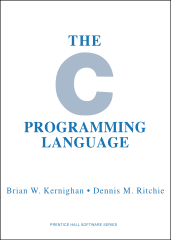
In 1978, Brian Kernighan and Dennis Ritchie published the first edition of The C Programming Language.[one] This volume, known to C programmers as K&R, served for many years every bit an informal specification of the language. The version of C that it describes is commonly referred to equally "Chiliad&R C". Every bit this was released in 1978, it is besides referred to as C78.[xv] The 2nd edition of the book[16] covers the later ANSI C standard, described below.
K&R introduced several language features:
- Standard I/O library
-
long intdata type -
unsigned intdata type - Chemical compound assignment operators of the form
=op(such as=-) were changed to the classop=(that is,-=) to remove the semantic ambiguity created by constructs such asi=-x, which had been interpreted asi =- 10(decrementipast 10) instead of the possibly intendedi = -ten(letibe −10).
Even after the publication of the 1989 ANSI standard, for many years G&R C was yet considered the "lowest common denominator" to which C programmers restricted themselves when maximum portability was desired, since many older compilers were nevertheless in use, and because carefully written K&R C code can exist legal Standard C equally well.
In early on versions of C, simply functions that return types other than int must be declared if used before the function definition; functions used without prior annunciation were presumed to return type int.
For instance:
long some_function (); /* int */ other_function (); /* int */ calling_function () { long test1 ; register /* int */ test2 ; test1 = some_function (); if ( test1 > 1 ) test2 = 0 ; else test2 = other_function (); return test2 ; } The int type specifiers which are commented out could be omitted in K&R C, simply are required in after standards.
Since One thousand&R function declarations did non include whatsoever information virtually function arguments, role parameter blazon checks were not performed, although some compilers would consequence a warning message if a local function was chosen with the wrong number of arguments, or if multiple calls to an external function used different numbers or types of arguments. Separate tools such equally Unix's lint utility were adult that (amidst other things) could bank check for consistency of part use across multiple source files.
In the years following the publication of Grand&R C, several features were added to the language, supported by compilers from AT&T (in detail PCC[17]) and some other vendors. These included:
-
voidfunctions (i.due east., functions with no return value) - functions returning
structorspousal relationshiptypes (rather than pointers) - assignment for
structdata types - enumerated types
The large number of extensions and lack of agreement on a standard library, together with the language popularity and the fact that non even the Unix compilers precisely implemented the K&R specification, led to the necessity of standardization.[ citation needed ]
ANSI C and ISO C [edit]
During the late 1970s and 1980s, versions of C were implemented for a wide variety of mainframe computers, minicomputers, and microcomputers, including the IBM PC, as its popularity began to increase significantly.
In 1983, the American National Standards Institute (ANSI) formed a committee, X3J11, to establish a standard specification of C. X3J11 based the C standard on the Unix implementation; notwithstanding, the non-portable portion of the Unix C library was handed off to the IEEE working group 1003 to go the ground for the 1988 POSIX standard. In 1989, the C standard was ratified as ANSI X3.159-1989 "Programming Language C". This version of the language is often referred to as ANSI C, Standard C, or sometimes C89.
In 1990, the ANSI C standard (with formatting changes) was adopted by the International Organization for Standardization (ISO) every bit ISO/IEC 9899:1990, which is sometimes called C90. Therefore, the terms "C89" and "C90" refer to the aforementioned programming language.
ANSI, like other national standards bodies, no longer develops the C standard independently, merely defers to the international C standard, maintained by the working group ISO/IEC JTC1/SC22/WG14. National adoption of an update to the international standard typically occurs within a year of ISO publication.
One of the aims of the C standardization process was to produce a superset of Grand&R C, incorporating many of the subsequently introduced unofficial features. The standards committee besides included several additional features such as part prototypes (borrowed from C++), void pointers, back up for international graphic symbol sets and locales, and preprocessor enhancements. Although the syntax for parameter declarations was augmented to include the way used in C++, the Chiliad&R interface continued to be permitted, for compatibility with existing source lawmaking.
C89 is supported by current C compilers, and most modern C lawmaking is based on information technology. Any program written but in Standard C and without any hardware-dependent assumptions will run correctly on whatsoever platform with a conforming C implementation, inside its resource limits. Without such precautions, programs may compile merely on a certain platform or with a particular compiler, due, for example, to the apply of not-standard libraries, such as GUI libraries, or to a reliance on compiler- or platform-specific attributes such as the verbal size of data types and byte endianness.
In cases where code must be compilable by either standard-conforming or K&R C-based compilers, the __STDC__ macro can exist used to split the code into Standard and Grand&R sections to forestall the use on a K&R C-based compiler of features bachelor only in Standard C.
After the ANSI/ISO standardization process, the C linguistic communication specification remained relatively static for several years. In 1995, Normative Amendment i to the 1990 C standard (ISO/IEC 9899/AMD1:1995, known informally every bit C95) was published, to correct some details and to add together more than extensive support for international graphic symbol sets.[xviii]
C99 [edit]

The C standard was further revised in the late 1990s, leading to the publication of ISO/IEC 9899:1999 in 1999, which is normally referred to as "C99". It has since been amended three times by Technical Corrigenda.[19]
C99 introduced several new features, including inline functions, several new data types (including long long int and a circuitous type to stand for circuitous numbers), variable-length arrays and flexible assortment members, improved support for IEEE 754 floating indicate, support for variadic macros (macros of variable arity), and support for one-line comments beginning with //, as in BCPL or C++. Many of these had already been implemented equally extensions in several C compilers.
C99 is for the most part backward compatible with C90, simply is stricter in some means; in detail, a declaration that lacks a type specifier no longer has int implicitly assumed. A standard macro __STDC_VERSION__ is divers with value 199901L to indicate that C99 support is bachelor. GCC, Solaris Studio, and other C compilers now support many or all of the new features of C99. The C compiler in Microsoft Visual C++, however, implements the C89 standard and those parts of C99 that are required for compatibility with C++xi.[xx] [ needs update ]
In addition, support for Unicode identifiers (variable / role names) in the form of escaped characters (e.g. \U0001f431) is now required. Support for raw Unicode names is optional.
C11 [edit]
In 2007, work began on another revision of the C standard, informally chosen "C1X" until its official publication on 2011-12-08. The C standards committee adopted guidelines to limit the adoption of new features that had not been tested by existing implementations.
The C11 standard adds numerous new features to C and the library, including type generic macros, anonymous structures, improved Unicode back up, diminutive operations, multi-threading, and bounds-checked functions. It likewise makes some portions of the existing C99 library optional, and improves compatibility with C++. The standard macro __STDC_VERSION__ is defined as 201112L to indicate that C11 back up is available.
C17 [edit]
Published in June 2018, C17 is the electric current standard for the C programming language. It introduces no new language features, but technical corrections, and clarifications to defects in C11. The standard macro __STDC_VERSION__ is defined as 201710L.
C2x [edit]
C2x is an informal proper name for the next (after C17) major C language standard revision. It is expected to be voted on in 2023 and would therefore exist called C23.[21] [ better source needed ]
Embedded C [edit]
Historically, embedded C programming requires nonstandard extensions to the C language in gild to support exotic features such as fixed-bespeak arithmetic, multiple distinct retentivity banks, and bones I/O operations.
In 2008, the C Standards Committee published a technical written report extending the C language[22] to address these issues by providing a mutual standard for all implementations to attach to. It includes a number of features not available in normal C, such every bit stock-still-point arithmetic, named accost spaces, and basic I/O hardware addressing.
Syntax [edit]
C has a formal grammar specified past the C standard.[23] Line endings are generally non significant in C; however, line boundaries do have significance during the preprocessing phase. Comments may appear either between the delimiters /* and */, or (since C99) post-obit // until the end of the line. Comments delimited by /* and */ practice not nest, and these sequences of characters are non interpreted as comment delimiters if they appear within cord or graphic symbol literals.[24]
C source files contain declarations and function definitions. Part definitions, in turn, incorporate declarations and statements. Declarations either ascertain new types using keywords such as struct, spousal relationship, and enum, or assign types to and perchance reserve storage for new variables, unremarkably by writing the type followed by the variable name. Keywords such every bit char and int specify built-in types. Sections of lawmaking are enclosed in braces ({ and }, sometimes called "curly brackets") to limit the scope of declarations and to human action as a single statement for control structures.
As an imperative language, C uses statements to specify actions. The most common argument is an expression statement, consisting of an expression to be evaluated, followed past a semicolon; as a side effect of the evaluation, functions may be called and variables may be assigned new values. To modify the normal sequential execution of statements, C provides several control-period statements identified by reserved keywords. Structured programming is supported by if … [else] conditional execution and by practice … while, while, and for iterative execution (looping). The for statement has separate initialization, testing, and reinitialization expressions, any or all of which can be omitted. break and continue can be used to go out the innermost enclosing loop argument or skip to its reinitialization. There is also a non-structured goto statement which branches directly to the designated characterization within the function. switch selects a case to exist executed based on the value of an integer expression.
Expressions can use a diverseness of built-in operators and may contain function calls. The order in which arguments to functions and operands to most operators are evaluated is unspecified. The evaluations may even be interleaved. However, all side effects (including storage to variables) will occur earlier the side by side "sequence signal"; sequence points include the end of each expression statement, and the entry to and return from each part telephone call. Sequence points also occur during evaluation of expressions containing certain operators (&&, ||, ?: and the comma operator). This permits a loftier degree of object lawmaking optimization by the compiler, but requires C programmers to have more care to obtain reliable results than is needed for other programming languages.
Kernighan and Ritchie say in the Introduction of The C Programming Language: "C, like any other linguistic communication, has its blemishes. Some of the operators have the wrong precedence; some parts of the syntax could exist meliorate."[25] The C standard did not endeavor to correct many of these blemishes, because of the impact of such changes on already existing software.
Graphic symbol set [edit]
The basic C source character fix includes the following characters:
- Lowercase and uppercase messages of ISO Basic Latin Alphabet:
a–zA–Z - Decimal digits:
0–nine - Graphic characters:
! " # % & ' ( ) * + , - . / : ; < = > ? [ \ ] ^ _ { | } ~ - Whitespace characters: space, horizontal tab, vertical tab, form feed, newline
Newline indicates the cease of a text line; it need non correspond to an bodily single character, although for convenience C treats it as one.
Additional multi-byte encoded characters may exist used in string literals, but they are not entirely portable. The latest C standard (C11) allows multi-national Unicode characters to be embedded portably inside C source text by using \uXXXX or \UXXXXXXXX encoding (where the X denotes a hexadecimal grapheme), although this feature is not still widely implemented.
The bones C execution graphic symbol set contains the same characters, along with representations for alert, backspace, and carriage render. Run-fourth dimension back up for extended character sets has increased with each revision of the C standard.
Reserved words [edit]
C89 has 32 reserved words, also known equally keywords, which are the words that cannot exist used for any purposes other than those for which they are predefined:
-
auto -
interruption -
case -
char -
const -
continue -
default -
exercise -
double -
else -
enum -
extern -
float -
for -
goto -
if -
int -
long -
register -
return -
short -
signed -
sizeof -
static -
struct -
switch -
typedef -
union -
unsigned -
void -
volatile -
while
C99 reserved five more words:
-
_Bool -
_Complex -
_Imaginary -
inline -
restrict
C11 reserved seven more words:[26]
-
_Alignas -
_Alignof -
_Atomic -
_Generic -
_Noreturn -
_Static_assert -
_Thread_local
Most of the recently reserved words begin with an underscore followed by a majuscule, because identifiers of that grade were previously reserved by the C standard for use only by implementations. Since existing program source code should not take been using these identifiers, information technology would non be affected when C implementations started supporting these extensions to the programming language. Some standard headers do define more user-friendly synonyms for underscored identifiers. The language previously included a reserved word called entry, but this was seldom implemented, and has now been removed every bit a reserved word.[27]
Operators [edit]
C supports a rich set of operators, which are symbols used within an expression to specify the manipulations to be performed while evaluating that expression. C has operators for:
- arithmetics:
+,-,*,/,% - assignment:
= - augmented assignment:
+=,-=,*=,/=,%=,&=,|=,^=,<<=,>>= - bitwise logic:
~,&,|,^ - bitwise shifts:
<<,>> - boolean logic:
!,&&,|| - conditional evaluation:
? : - equality testing:
==,!= - calling functions:
( ) - increase and decrement:
++,-- - member selection:
.,-> - object size:
sizeof - order relations:
<,<=,>,>= - reference and dereference:
&,*,[ ] - sequencing:
, - subexpression grouping:
( ) - blazon conversion:
(typename)
C uses the operator = (used in mathematics to express equality) to indicate consignment, following the precedent of Fortran and PL/I, but unlike ALGOL and its derivatives. C uses the operator == to test for equality. The similarity between these 2 operators (assignment and equality) may result in the accidental use of 1 in identify of the other, and in many cases, the mistake does not produce an error bulletin (although some compilers produce warnings). For example, the conditional expression if (a == b + one) might mistakenly be written every bit if (a = b + one), which volition be evaluated every bit true if a is not zero later the assignment.[28]
The C operator precedence is not ever intuitive. For example, the operator == binds more tightly than (is executed prior to) the operators & (bitwise AND) and | (bitwise OR) in expressions such every bit x & 1 == 0, which must be written as (10 & i) == 0 if that is the coder'south intent.[29]
"Hello, earth" instance [edit]

The "howdy, world" example, which appeared in the offset edition of K&R, has go the model for an introductory program in most programming textbooks. The plan prints "hello, world" to the standard output, which is usually a terminal or screen display.
The original version was:[30]
master () { printf ( "hi, earth \n " ); } A standard-conforming "hello, world" program is:[a]
#include <stdio.h> int main ( void ) { printf ( "hi, world \northward " ); } The first line of the program contains a preprocessing directive, indicated by #include. This causes the compiler to supplant that line with the unabridged text of the stdio.h standard header, which contains declarations for standard input and output functions such as printf and scanf. The angle brackets surrounding stdio.h indicate that stdio.h is located using a search strategy that prefers headers provided with the compiler to other headers having the same name, equally opposed to double quotes which typically include local or project-specific header files.
The next line indicates that a function named principal is existence defined. The main office serves a special purpose in C programs; the run-time environment calls the chief office to brainstorm program execution. The type specifier int indicates that the value that is returned to the invoker (in this example the run-fourth dimension environment) equally a result of evaluating the master role, is an integer. The keyword void as a parameter listing indicates that this office takes no arguments.[b]
The opening curly brace indicates the starting time of the definition of the main function.
The next line calls (diverts execution to) a role named printf, which in this example is supplied from a system library. In this call, the printf part is passed (provided with) a single argument, the address of the first character in the string literal "hello, earth\n". The string literal is an unnamed array with elements of type char, set up automatically past the compiler with a final 0-valued character to mark the stop of the assortment (printf needs to know this). The \north is an escape sequence that C translates to a newline graphic symbol, which on output signifies the end of the current line. The return value of the printf function is of type int, but information technology is silently discarded since it is not used. (A more conscientious program might test the return value to decide whether or not the printf function succeeded.) The semicolon ; terminates the statement.
The closing curly brace indicates the end of the code for the primary part. According to the C99 specification and newer, the main function, dissimilar any other office, will implicitly return a value of 0 upon reaching the } that terminates the function. (Formerly an explicit return 0; argument was required.) This is interpreted by the run-time system as an exit code indicating successful execution.[31]
Data types [edit]
The type arrangement in C is static and weakly typed, which makes information technology like to the type organisation of ALGOL descendants such as Pascal.[32] There are born types for integers of various sizes, both signed and unsigned, floating-point numbers, and enumerated types (enum). Integer blazon char is often used for single-byte characters. C99 added a boolean datatype. There are also derived types including arrays, pointers, records (struct), and unions (matrimony).
C is oft used in low-level systems programming where escapes from the type system may be necessary. The compiler attempts to ensure blazon definiteness of about expressions, merely the developer can override the checks in various ways, either by using a type bandage to explicitly convert a value from one type to another, or past using pointers or unions to reinterpret the underlying bits of a information object in some other way.
Some find C's annunciation syntax unintuitive, especially for function pointers. (Ritchie's idea was to declare identifiers in contexts resembling their use: "declaration reflects utilise".)[33]
C'due south usual arithmetic conversions allow for efficient code to be generated, but tin sometimes produce unexpected results. For example, a comparison of signed and unsigned integers of equal width requires a conversion of the signed value to unsigned. This can generate unexpected results if the signed value is negative.
Pointers [edit]
C supports the use of pointers, a blazon of reference that records the address or location of an object or function in memory. Pointers tin be dereferenced to access data stored at the address pointed to, or to invoke a pointed-to office. Pointers tin can be manipulated using assignment or pointer arithmetic. The run-time representation of a pointer value is typically a raw memory address (perhaps augmented by an offset-within-give-and-take field), just since a pointer'south blazon includes the type of the matter pointed to, expressions including pointers tin exist blazon-checked at compile fourth dimension. Pointer arithmetic is automatically scaled by the size of the pointed-to data type. Pointers are used for many purposes in C. Text strings are commonly manipulated using pointers into arrays of characters. Dynamic retention allocation is performed using pointers. Many data types, such as trees, are unremarkably implemented as dynamically allocated struct objects linked together using pointers. Pointers to functions are useful for passing functions equally arguments to higher-order functions (such every bit qsort or bsearch) or as callbacks to be invoked by result handlers.[31]
A null pointer value explicitly points to no valid location. Dereferencing a null pointer value is undefined, often resulting in a partitioning fault. Nil pointer values are useful for indicating special cases such as no "next" pointer in the last node of a linked listing, or as an error indication from functions returning pointers. In advisable contexts in source code, such as for assigning to a pointer variable, a null pointer abiding can be written as 0, with or without explicit casting to a pointer type, or every bit the Cipher macro defined by several standard headers. In conditional contexts, goose egg pointer values evaluate to imitation, while all other pointer values evaluate to true.
Void pointers (void *) point to objects of unspecified blazon, and can therefore be used as "generic" data pointers. Since the size and type of the pointed-to object is not known, void pointers cannot be dereferenced, nor is pointer arithmetic on them allowed, although they can hands be (and in many contexts implicitly are) converted to and from whatever other object pointer blazon.[31]
Devil-may-care use of pointers is potentially dangerous. Considering they are typically unchecked, a pointer variable tin can exist made to point to whatever arbitrary location, which can crusade undesirable effects. Although properly used pointers point to safe places, they tin can exist made to point to dangerous places past using invalid pointer arithmetic; the objects they point to may proceed to exist used after deallocation (dangling pointers); they may be used without having been initialized (wild pointers); or they may exist directly assigned an unsafe value using a cast, spousal relationship, or through another corrupt pointer. In general, C is permissive in allowing manipulation of and conversion betwixt arrow types, although compilers typically provide options for diverse levels of checking. Some other programming languages accost these problems past using more restrictive reference types.
Arrays [edit]
Array types in C are traditionally of a fixed, static size specified at compile time. The more contempo C99 standard also allows a form of variable-length arrays. Still, it is also possible to allocate a cake of retention (of capricious size) at run-time, using the standard library's malloc function, and care for it as an assortment.
Since arrays are always accessed (in consequence) via pointers, array accesses are typically non checked against the underlying array size, although some compilers may provide bounds checking as an selection.[34] [35] Assortment bounds violations are therefore possible and can lead to various repercussions, including illegal retention accesses, corruption of data, buffer overruns, and run-time exceptions.
C does non have a special provision for declaring multi-dimensional arrays, only rather relies on recursion within the type system to declare arrays of arrays, which effectively accomplishes the same thing. The index values of the resulting "multi-dimensional array" tin be thought of as increasing in row-major guild. Multi-dimensional arrays are normally used in numerical algorithms (mainly from applied linear algebra) to store matrices. The construction of the C array is well suited to this particular task. However, in early versions of C the bounds of the assortment must be known fixed values or else explicitly passed to any subroutine that requires them, and dynamically sized arrays of arrays cannot exist accessed using double indexing. (A workaround for this was to classify the assortment with an additional "row vector" of pointers to the columns.) C99 introduced "variable-length arrays" which accost this issue.
The following example using modern C (C99 or later) shows resource allotment of a ii-dimensional assortment on the heap and the use of multi-dimensional array indexing for accesses (which can use bounds-checking on many C compilers):
int func ( int N , int 1000 ) { bladder ( * p )[ N ][ M ] = malloc ( sizeof * p ); if ( ! p ) return -1 ; for ( int i = 0 ; i < Due north ; i ++ ) for ( int j = 0 ; j < M ; j ++ ) ( * p )[ i ][ j ] = i + j ; print_array ( N , Grand , p ); free ( p ); render 1 ; } And here is a similar implementation using C99's Auto VLA feature:
int func ( int Northward , int M ) { // Caution: checks should exist fabricated to ensure N*1000*sizeof(float) does NOT exceed limitations for car VLAs and is inside available size of stack. float p [ N ][ M ]; // machine VLA is held on the stack, and sized when the function is invoked for ( int i = 0 ; i < Due north ; i ++ ) for ( int j = 0 ; j < Yard ; j ++ ) p [ i ][ j ] = i + j ; // no need to free(p) since it will disappear when the function exits, along with the rest of the stack frame return 1 ; } Array–arrow interchangeability [edit]
The subscript notation x[i] (where x designates a pointer) is syntactic carbohydrate for *(x+i).[36] Taking advantage of the compiler's knowledge of the pointer type, the accost that x + i points to is non the base of operations address (pointed to by 10) incremented by i bytes, but rather is divers to be the base accost incremented past i multiplied by the size of an element that 10 points to. Thus, 10[i] designates the i+aneth element of the array.
Furthermore, in nigh expression contexts (a notable exception is every bit operand of sizeof), an expression of array blazon is automatically converted to a arrow to the array's outset element. This implies that an array is never copied as a whole when named as an statement to a office, merely rather only the address of its first element is passed. Therefore, although function calls in C use laissez passer-past-value semantics, arrays are in result passed by reference.
The full size of an array x can exist determined by applying sizeof to an expression of array type. The size of an element can be determined past applying the operator sizeof to whatsoever dereferenced element of an assortment A, every bit in n = sizeof A[0]. This, the number of elements in a declared array A tin can exist adamant every bit sizeof A / sizeof A[0]. Annotation, that if only a pointer to the commencement element is bachelor as it is often the case in C code because of the automatic conversion described above, the data about the total type of the array and its length are lost.
Memory direction [edit]
One of the nearly of import functions of a programming linguistic communication is to provide facilities for managing retentivity and the objects that are stored in memory. C provides three primary ways to allocate retentivity for objects:[31]
- Static retention allocation: space for the object is provided in the binary at compile-time; these objects have an extent (or lifetime) equally long equally the binary which contains them is loaded into memory.
- Automatic memory allotment: temporary objects tin can be stored on the stack, and this space is automatically freed and reusable after the block in which they are alleged is exited.
- Dynamic retentivity resource allotment: blocks of memory of capricious size tin can be requested at run-fourth dimension using library functions such every bit
mallocfrom a region of memory called the heap; these blocks persist until subsequently freed for reuse past calling the library partreallocorfree
These three approaches are advisable in unlike situations and have diverse trade-offs. For example, static memory allocation has footling allotment overhead, automated allocation may involve slightly more than overhead, and dynamic retentiveness allotment can potentially have a slap-up deal of overhead for both allotment and deallocation. The persistent nature of static objects is useful for maintaining state information across function calls, automated allocation is easy to use but stack space is typically much more express and transient than either static memory or heap space, and dynamic memory allocation allows user-friendly resource allotment of objects whose size is known just at run-time. Almost C programs make all-encompassing utilise of all three.
Where possible, automatic or static allocation is usually simplest because the storage is managed by the compiler, freeing the programmer of the potentially error-prone chore of manually allocating and releasing storage. Notwithstanding, many data structures tin can change in size at runtime, and since static allocations (and automatic allocations before C99) must accept a fixed size at compile-time, there are many situations in which dynamic allocation is necessary.[31] Prior to the C99 standard, variable-sized arrays were a common example of this. (See the article on malloc for an case of dynamically allocated arrays.) Unlike automatic allocation, which can fail at run fourth dimension with uncontrolled consequences, the dynamic allocation functions return an indication (in the form of a null arrow value) when the required storage cannot exist allocated. (Static allocation that is besides large is normally detected by the linker or loader, before the programme can fifty-fifty brainstorm execution.)
Unless otherwise specified, static objects contain zero or zip arrow values upon program startup. Automatically and dynamically allocated objects are initialized only if an initial value is explicitly specified; otherwise they initially have indeterminate values (typically, whatever bit blueprint happens to be present in the storage, which might not even correspond a valid value for that type). If the program attempts to admission an uninitialized value, the results are undefined. Many modern compilers try to observe and warn about this problem, but both fake positives and false negatives can occur.
Heap memory allocation has to be synchronized with its bodily usage in any program to be reused every bit much as possible. For instance, if the only arrow to a heap retentiveness resource allotment goes out of scope or has its value overwritten before it is deallocated explicitly, so that memory cannot be recovered for later reuse and is essentially lost to the program, a miracle known as a memory leak. Conversely, it is possible for memory to be freed, merely is referenced later, leading to unpredictable results. Typically, the failure symptoms appear in a portion of the program unrelated to the lawmaking that causes the error, making it difficult to diagnose the failure. Such bug are ameliorated in languages with automated garbage drove.
Libraries [edit]
The C programming language uses libraries as its main method of extension. In C, a library is a ready of functions independent within a single "annal" file. Each library typically has a header file, which contains the prototypes of the functions contained within the library that may be used by a plan, and declarations of special data types and macro symbols used with these functions. In guild for a plan to use a library, it must include the library's header file, and the library must be linked with the program, which in many cases requires compiler flags (eastward.g., -lm, shorthand for "link the math library").[31]
The well-nigh common C library is the C standard library, which is specified by the ISO and ANSI C standards and comes with every C implementation (implementations which target limited environments such as embedded systems may provide only a subset of the standard library). This library supports stream input and output, memory allocation, mathematics, graphic symbol strings, and time values. Several separate standard headers (for example, stdio.h) specify the interfaces for these and other standard library facilities.
Another mutual fix of C library functions are those used by applications specifically targeted for Unix and Unix-like systems, especially functions which provide an interface to the kernel. These functions are detailed in various standards such as POSIX and the Single UNIX Specification.
Since many programs have been written in C, there are a broad variety of other libraries available. Libraries are often written in C because C compilers generate efficient object code; programmers and then create interfaces to the library then that the routines can be used from higher-level languages like Java, Perl, and Python.[31]
File handling and streams [edit]
File input and output (I/O) is not role of the C linguistic communication itself simply instead is handled past libraries (such every bit the C standard library) and their associated header files (e.yard. stdio.h). File handling is generally implemented through loftier-level I/O which works through streams. A stream is from this perspective a data menstruation that is independent of devices, while a file is a concrete device. The loftier-level I/O is done through the association of a stream to a file. In the C standard library, a buffer (a memory area or queue) is temporarily used to store information before it's sent to the terminal destination. This reduces the time spent waiting for slower devices, for example a hard drive or solid country drive. Depression-level I/O functions are not office of the standard C library[ clarification needed ] merely are generally part of "bare metal" programming (programming that's independent of any operating system such every bit near embedded programming). With few exceptions, implementations include low-level I/O.
Language tools [edit]
A number of tools have been developed to assistance C programmers find and fix statements with undefined behavior or perchance erroneous expressions, with greater rigor than that provided by the compiler. The tool lint was the first such, leading to many others.
Automated source code checking and auditing are beneficial in any linguistic communication, and for C many such tools exist, such as Lint. A common practice is to apply Lint to detect questionable code when a program is offset written. In one case a programme passes Lint, it is then compiled using the C compiler. Likewise, many compilers can optionally warn about syntactically valid constructs that are likely to actually be errors. MISRA C is a proprietary set of guidelines to avoid such questionable code, developed for embedded systems.[37]
In that location are also compilers, libraries, and operating arrangement level mechanisms for performing actions that are not a standard role of C, such as bounds checking for arrays, detection of buffer overflow, serialization, dynamic memory tracking, and automatic garbage collection.
Tools such as Purify or Valgrind and linking with libraries containing special versions of the memory allocation functions tin assistance uncover runtime errors in memory usage.
Uses [edit]
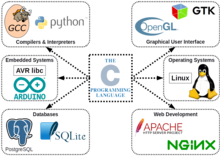
The C Programming Language
C is widely used for systems programming in implementing operating systems and embedded arrangement applications.[38] This is for several reasons:
- The code generated afterwards compilation doesn't demand many system features, and can exist invoked from some kicking lawmaking in a straightforward mode - it's simple to execute.
- The C language statements and expressions typically map well on to sequences of instructions for the target processor, and consequently there is a depression run-time demand on system resources - it's fast to execute.
- The language makes it easy to overlay structures onto blocks of binary data, allowing the information to be comprehended, navigated and modified - it can write data structures, even file systems.
- The language supports a rich set up of operators, including flake manipulation, for integer arithmetic and logic, and peradventure unlike sizes of floating signal numbers - information technology can process appropriately-structured information effectively.
- Platform hardware can exist accessed with pointers and blazon punning, and then system-specific features (e.chiliad. Control/Condition Registers, I/O registers) can be configured and used with code written in C - it interacts well with the platform information technology's running on.
- Depending on the linker and surround, C code can too call libraries written in assembly language, and may be called from assembly language - it interoperates well with other code.
- C has a very mature and broad ecosystem, including open source compilers, debuggers and utilities, and is the de-facto standard. It's likely the drivers already be in C, or that there is a similar CPU architecture as a back-end of a C compiler, so there is reduced incentive to cull some other linguistic communication.
Historically, C was sometimes used for web development using the Common Gateway Interface (CGI) equally a "gateway" for data between the web awarding, the server, and the browser.[39] C may accept been chosen over interpreted languages because of its speed, stability, and nigh-universal availability.[40] It is no longer common practice for web development to be washed in C,[41] and many other web development tools exist.
A consequence of C'southward wide availability and efficiency is that compilers, libraries and interpreters of other programming languages are often implemented in C. For case, the reference implementations of Python, Perl, Ruddy, and PHP are written in C.
C enables programmers to create efficient implementations of algorithms and data structures, considering the layer of abstraction from hardware is thin, and its overhead is low, an important criterion for computationally intensive programs. For example, the GNU Multiple Precision Arithmetic Library, the GNU Scientific Library, Mathematica, and MATLAB are completely or partially written in C. Many languages support calling library functions in C, for case, the Python-based framework NumPy uses C for the high-operation and hardware-interacting aspects.
C is sometimes used as an intermediate linguistic communication past implementations of other languages. This approach may exist used for portability or convenience; by using C as an intermediate language, additional auto-specific lawmaking generators are not necessary. C has some features, such as line-number preprocessor directives and optional superfluous commas at the stop of initializer lists, that support compilation of generated lawmaking. However, some of C's shortcomings take prompted the evolution of other C-based languages specifically designed for use as intermediate languages, such as C--.
C has besides been widely used to implement end-user applications.[ citation needed ] However, such applications can also be written in newer, higher-level languages.
Limitations [edit]
While C has been popular, influential and hugely successful, it has drawbacks, including:
- The use of pointers and the directly manipulation of memory means corruption of memory is possible, perhaps due to programmer error, or bereft checking of bad data.
- Since the code generated by the compiler contains few checks itself, there is a brunt on the programmer to consider all possible outcomes, and protect confronting buffer overruns, array premises checking, stack overflows, retention exhaustion, race weather, thread isolation, etc.
- The use of pointers and the run-time manipulation of these ways in that location may be two means to admission the aforementioned data (aliasing), which is not determinable at compile time. This means that some optimisations that may exist available to other languages are not possible in C. FORTRAN is considered faster.
- There is express standardisation in support for low-level variants in generated code, for example: different part calling conventions; unlike structure packing conventions; different byte ordering inside larger integers (including endianness). In many language implementations, some of these options may be handled with the preprocessor directive
#pragma,[42] and some with additional keywords e.k. use__cdeclcalling convention. Just the directive and options are not consistently supported.[43] - The language does not direct support object orientation, introspection, run-time expression evaluation, generics, exceptions.
- There are few guards confronting inappropriate use of linguistic communication features, which may lead to unmaintainable code.
For some purposes, restricted styles of C have been adopted, e.g. MISRA C, in an try to reduce the opportunity for bugs. In that location are tools that tin mitigate against some of these drawbacks. Some of these drawbacks accept prompted the structure of other languages.
[edit]

The TIOBE index graph, showing a comparison of the popularity of diverse programming languages[44]
C has both directly and indirectly influenced many later languages such equally C#, D, Go, Java, JavaScript, Limbo, LPC, Perl, PHP, Python, and Unix's C shell.[45] The well-nigh pervasive influence has been syntactical; all of the languages mentioned combine the statement and (more or less recognizably) expression syntax of C with blazon systems, information models, and/or big-scale program structures that differ from those of C, sometimes radically.
Several C or virtually-C interpreters exist, including Ch and CINT, which can also be used for scripting.
When object-oriented programming languages became pop, C++ and Objective-C were ii different extensions of C that provided object-oriented capabilities. Both languages were originally implemented every bit source-to-source compilers; source code was translated into C, and then compiled with a C compiler.[46]
The C++ programming language (originally named "C with Classes") was devised by Bjarne Stroustrup equally an arroyo to providing object-oriented functionality with a C-like syntax.[47] C++ adds greater typing strength, scoping, and other tools useful in object-oriented programming, and permits generic programming via templates. Well-nigh a superset of C, C++ now supports near of C, with a few exceptions.
Objective-C was originally a very "thin" layer on top of C, and remains a strict superset of C that permits object-oriented programming using a hybrid dynamic/static typing paradigm. Objective-C derives its syntax from both C and Smalltalk: syntax that involves preprocessing, expressions, office declarations, and function calls is inherited from C, while the syntax for object-oriented features was originally taken from Smalltalk.
In add-on to C++ and Objective-C, Ch, Cilk, and Unified Parallel C are nearly supersets of C.
See also [edit]
- Compatibility of C and C++
- Comparison of Pascal and C
- Comparing of programming languages
- International Obfuscated C Code Competition
- List of C-based programming languages
- List of C compilers
Notes [edit]
- ^ The original example code volition compile on nigh modern compilers that are not in strict standard compliance mode, only it does not fully conform to the requirements of either C89 or C99. In fact, C99 requires that a diagnostic bulletin exist produced.
- ^ The
mainoffice actually has two arguments,int argcandchar *argv[], respectively, which tin can be used to handle command line arguments. The ISO C standard (section 5.one.2.2.1) requires both forms ofprincipalto be supported, which is special treatment not afforded to any other office.
References [edit]
- ^ a b Kernighan, Brian Westward.; Ritchie, Dennis K. (February 1978). The C Programming Linguistic communication (1st ed.). Englewood Cliffs, NJ: Prentice Hall. ISBN978-0-13-110163-0.
- ^ Ritchie (1993): "Thompson had made a brief try to produce a system coded in an early version of C—before structures—in 1972, but gave up the effort."
- ^ Fruderica (December 13, 2020). "History of C". The cppreference.com. Archived from the original on Oct 24, 2020. Retrieved October 24, 2020.
- ^ Ritchie (1993): "The scheme of type composition adopted past C owes considerable debt to Algol 68, although it did not, maybe, emerge in a grade that Algol'south adherents would approve of."
- ^ a b "Verilog HDL (and C)" (PDF). The Research School of Computer Science at the Australian National University. June 3, 2010. Archived from the original (PDF) on November half dozen, 2013. Retrieved August nineteen, 2013.
1980s: ; Verilog showtime introduced ; Verilog inspired past the C programming language
- ^ a b c d e f Ritchie (1993)
- ^ "Programming Language Popularity". 2009. Archived from the original on Jan xvi, 2009. Retrieved January sixteen, 2009.
- ^ "TIOBE Programming Community Alphabetize". 2009. Archived from the original on May 4, 2009. Retrieved May 6, 2009.
- ^ a b "History of C". en.cppreference.com. Archived from the original on May 29, 2018. Retrieved May 28, 2018.
- ^ "TIOBE Alphabetize for October 2021". Retrieved October 7, 2021.
- ^ Ritchie, Dennis. "BCPL to B to C". Archived from the original on December 12, 2019. Retrieved September 10, 2019.
- ^ a b c d e Jensen, Richard (Dec 9, 2020). ""A damn stupid thing to do"—the origins of C". Ars Technica . Retrieved March 28, 2022.
- ^ a b Johnson, Due south. C.; Ritchie, D. 1000. (1978). "Portability of C Programs and the UNIX System". Bong System Tech. J. 57 (six): 2021–2048. CiteSeerXx.1.ane.138.35. doi:10.1002/j.1538-7305.1978.tb02141.ten. S2CID 17510065. (Note: The PDF is an OCR scan of the original, and contains a rendering of "IBM 370" equally "IBM 310".)
- ^ McIlroy, M. D. (1987). A Inquiry Unix reader: annotated excerpts from the Developer's Manual, 1971–1986 (PDF) (Technical report). CSTR. Bong Labs. p. 10. 139. Archived (PDF) from the original on November 11, 2017. Retrieved February 1, 2015.
- ^ "C manual pages". FreeBSD Miscellaneous Data Manual (FreeBSD 13.0 ed.). May thirty, 2011. Archived from the original on January 21, 2021. Retrieved Jan 15, 2021. [one] Archived Jan 21, 2021, at the Wayback Machine
- ^ Kernighan, Brian West.; Ritchie, Dennis One thousand. (March 1988). The C Programming Language (2nd ed.). Englewood Cliffs, NJ: Prentice Hall. ISBN978-0-13-110362-7.
- ^ Stroustrup, Bjarne (2002). Sibling rivalry: C and C++ (PDF) (Study). AT&T Labs. Archived (PDF) from the original on Baronial 24, 2014. Retrieved Apr xiv, 2014.
- ^ C Integrity. International System for Standardization. March 30, 1995. Archived from the original on July 25, 2018. Retrieved July 24, 2018.
- ^ "JTC1/SC22/WG14 – C". Dwelling house page. ISO/IEC. Archived from the original on February 12, 2018. Retrieved June ii, 2011.
- ^ Andrew Binstock (October 12, 2011). "Interview with Herb Sutter". Dr. Dobbs. Archived from the original on August two, 2013. Retrieved September seven, 2013.
- ^ "Revised C23 Schedule WG 14 Northward 2759" (PDF). www.open-std.org. Archived (PDF) from the original on June 24, 2021. Retrieved October 10, 2021.
- ^ "TR 18037: Embedded C" (PDF). ISO / IEC. Archived (PDF) from the original on February 25, 2021. Retrieved July 26, 2011.
- ^ Harbison, Samuel P.; Steele, Guy L. (2002). C: A Reference Manual (5th ed.). Englewood Cliffs, NJ: Prentice Hall. ISBN978-0-13-089592-9. Contains a BNF grammar for C.
- ^ Kernighan & Ritchie (1996), p. 192.
- ^ Kernighan & Ritchie (1978), p. 3.
- ^ "ISO/IEC 9899:201x (ISO C11) Commission Typhoon" (PDF). Archived (PDF) from the original on December 22, 2017. Retrieved September 16, 2011.
- ^ Kernighan & Ritchie (1996), pp. 192, 259.
- ^ "10 Mutual Programming Mistakes in C++". Cs.ucr.edu. Archived from the original on October 21, 2008. Retrieved June 26, 2009.
- ^ Schultz, Thomas (2004). C and the 8051 (third ed.). Otsego, MI: PageFree Publishing Inc. p. twenty. ISBN978-i-58961-237-2. Archived from the original on July 29, 2020. Retrieved February 10, 2012.
- ^ Kernighan & Ritchie (1978), p. half dozen.
- ^ a b c d eastward f g Klemens, Ben (2013). 21st Century C. O'Reilly Media. ISBN978-1-4493-2714-nine.
- ^ Feuer, Alan R.; Gehani, Narain H. (March 1982). "Comparison of the Programming Languages C and Pascal". ACM Calculating Surveys. 14 (1): 73–92. doi:10.1145/356869.356872. S2CID 3136859.
- ^ Kernighan & Ritchie (1996), p. 122.
- ^ For instance, gcc provides _FORTIFY_SOURCE. "Security Features: Compile Fourth dimension Buffer Checks (FORTIFY_SOURCE)". fedoraproject.org. Archived from the original on January seven, 2007. Retrieved August 5, 2012.
- ^ เอี่ยมสิริวงศ์, โอภาศ (2016). Programming with C. Bangkok, Thailand: SE-EDUCATION PUBLIC Company Limited. pp. 225–230. ISBN978-616-08-2740-4.
- ^ Raymond, Eric Southward. (Oct eleven, 1996). The New Hacker's Dictionary (3rd ed.). MIT Press. p. 432. ISBN978-0-262-68092-9. Archived from the original on Nov 12, 2012. Retrieved August five, 2012.
- ^ "Homo Folio for lint (freebsd Section 1)". unix.com. May 24, 2001. Retrieved July 15, 2014.
- ^ Dale, Nell B.; Weems, Bit (2014). Programming and problem solving with C++ (6th ed.). Burlington, MA: Jones & Bartlett Learning. ISBN978-1449694289. OCLC 894992484.
- ^ Dr. Dobb's Sourcebook. U.S.A.: Miller Freeman, Inc. November–December 1995.
- ^ "Using C for CGI Programming". linuxjournal.com. March 1, 2005. Archived from the original on February 13, 2010. Retrieved January four, 2010.
- ^ Perkins, Luc (September 17, 2013). "Web development in C: crazy? Or crazy like a fox?". Medium.
- ^ "#pragma Directive in C/C++". GeeksforGeeks. September xi, 2018. Retrieved April 10, 2022.
- ^ "Pragmas". Intel . Retrieved April x, 2022.
- ^ McMillan, Robert (Baronial i, 2013). "Is Java Losing Its Mojo?". Wired. Archived from the original on Feb 15, 2017. Retrieved March 5, 2017.
- ^ O'Regan, Gerard (September 24, 2015). Pillars of computing : a compendium of select, pivotal engineering firms. ISBN978-3319214641. OCLC 922324121.
- ^ Rauchwerger, Lawrence (2004). Languages and compilers for parallel computing : 16th international workshop, LCPC 2003, Higher Station, TX, Us, October 2-4, 2003 : revised papers. Springer. ISBN978-3540246442. OCLC 57965544.
- ^ Stroustrup, Bjarne (1993). "A History of C++: 1979−1991" (PDF). Archived (PDF) from the original on February 2, 2019. Retrieved June ix, 2011.
Sources [edit]
- Ritchie, Dennis 1000. (March 1993). "The Development of the C Language". ACM SIGPLAN Notices. ACM. 28 (3): 201–208. doi:x.1145/155360.155580.
- By courtesy of the author, also at Ritchie, Dennis G. "Chistory". www.bell-labs.com . Retrieved March 29, 2022.
- Ritchie, Dennis M. (1993). "The Development of the C Linguistic communication". The Second ACM SIGPLAN Conference on History of Programming Languages (HOPL-II). ACM. pp. 201–208. doi:10.1145/154766.155580. ISBN0-89791-570-4 . Retrieved Nov 4, 2014.
- Kernighan, Brian West.; Ritchie, Dennis M. (1996). The C Programming Language (2nd ed.). Prentice Hall. ISBNvii-302-02412-X.
Further reading [edit]
- Kernighan, Brian; Ritchie, Dennis (1988). The C Programming Language (2 ed.). Prentice Hall. ISBN978-0131103627. (archive)
- Plauger, P.J. (1992). The Standard C Library (i ed.). Prentice Hall. ISBN978-0131315099. (source)
- Banahan, M.; Brady, D.; Doran, Yard. (1991). The C Volume: Featuring the ANSI C Standard (2 ed.). Addison-Wesley. ISBN978-0201544336. (free)
- Harbison, Samuel; Steele Jr, Guy (2002). C: A Reference Manual (five ed.). Pearson. ISBN978-0130895929. (annal)
- King, K.N. (2008). C Programming: A Modern Approach (ii ed.). West. W. Norton. ISBN978-0393979503. (archive)
- Griffiths, David; Griffiths, Dawn (2012). Head First C (1 ed.). O'Reilly. ISBN978-1449399917.
- Perry, Greg; Miller, Dean (2013). C Programming: Accented Beginner'due south Guide (three ed.). Que. ISBN978-0789751980.
- Deitel, Paul; Deitel, Harvey (2015). C: How to Program (8 ed.). Pearson. ISBN978-0133976892.
- Gustedt, Jens (2019). Modernistic C (two ed.). Manning. ISBN978-1617295812. (free)
External links [edit]
- ISO C Working Group official website
- ISO/IEC 9899, publicly bachelor official C documents, including the C99 Rationale
- "C99 with Technical corrigenda TC1, TC2, and TC3 included" (PDF). (3.61 MB)
- comp.lang.c Ofttimes Asked Questions
- A History of C, by Dennis Ritchie
bardenalievespecon67.blogspot.com
Source: https://en.wikipedia.org/wiki/C_(programming_language)
0 Response to "C# Mvc Authenticate to Upload File to Server"
ارسال یک نظر